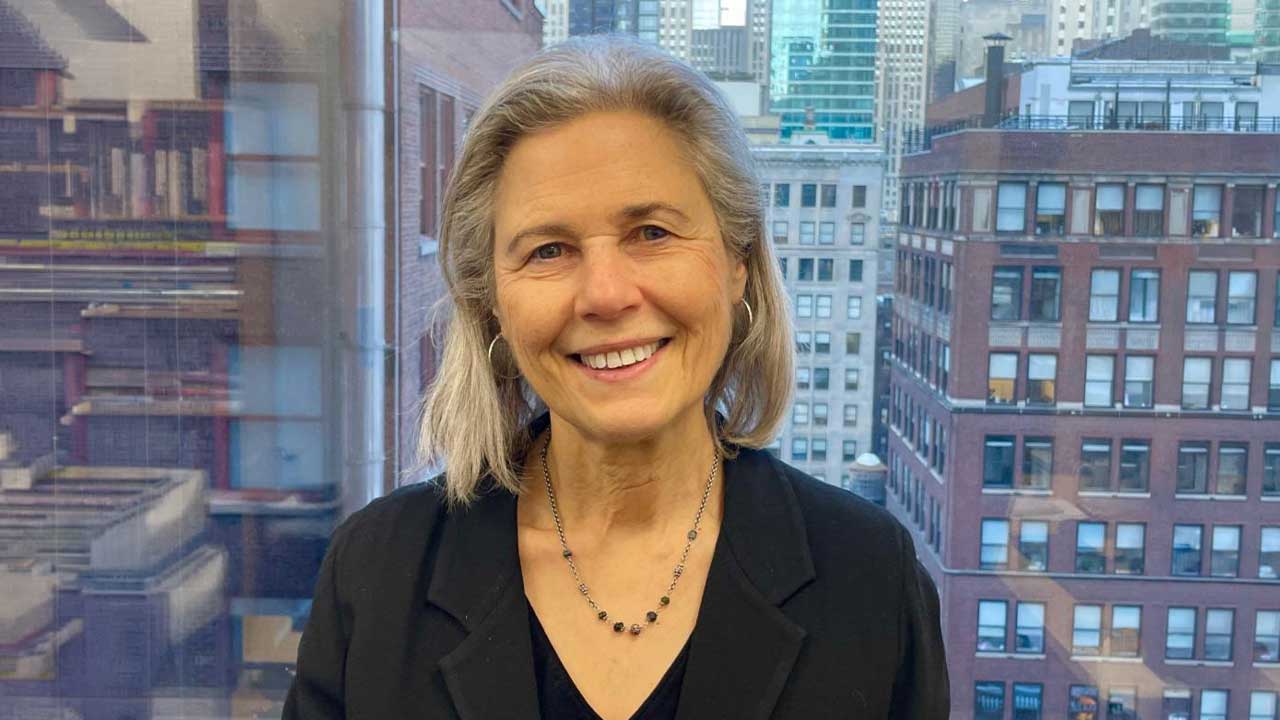
Distinguished Lecturer in Labor Studies Ellen Dichner is a labor lawyer with deep experience representing workers and unions. Prior to joining the SLU faculty, she served as Chief Counsel to the Chairman of the National Labor Relations Board in Washington during the Obama administration. During Dichner’s tenure, the Board issued major decisions that expanded protections for workers who seek to unionize and improved their working conditions.As she was leaving the NLRB, Dichner (pronounced DITCH-ner) did not anticipate teaching until a peer mentioned a job opening at the School of Labor and Urban Studies. That led to Dichner teaching graduate courses in labor law and arbitration and becoming one of SLU’s most impactful instructors, according to her students. She also teaches in CSTEP Project L.A.W., a program aimed at diversifying law school classes.
Dichner grew up in Massachusetts and got a bachelor’s degree in government at Oberlin College in Ohio. She received her law degree from Northeastern University in Boston. She spent most of her career as a partner at Gladstein, Reif & Meginniss, a Manhattan law firm specializing in representing workers and labor unions. She has two grown sons and one granddaughter, and lives with her lawyer husband in Brooklyn.
Why teach Labor Law?
The ability to be able to pass along my experience and skills to the next generation of troublemakers: I couldn’t ask for more.
What made you a professor?
I was winding down my career at the NLRB, and Steve Brier told me SLU was hiring a distinguished lecturer. (CUNY Graduate Center Professor Emeritus Stephen Brier taught labor history at SLU.) It was great timing. I did not want to return to the private practice of law, and this presented an amazing opportunity for me to utilize my skills to help grow the labor movement.
What do you find special about SLU?
The students. I get to spend two and a half hours in class with all these interesting people who are very enthusiastic and have a keen interest in strengthening the labor movement. Students enrich our discussions with their varying perspectives. And they never hesitate to challenge the premises and the limits of the law! It’s very stimulating.
It’s great to be able to talk about what I have been thinking about for decades, what I like to talk about, what I know, what I’ve spent my life doing — and in such a rich environment of outstanding scholars and insightful students.
What do you find special about SLU students?
It’s a very diverse group. So many of the students are sponges. They’re very engaged. It’s often difficult for me to get through my lectures because students have a lot of questions!
The study of labor law requires students to think in a different way. There’s a very technical and methodical aspect of legal reasoning. Then there’s always a discussion about the relevance of the law: How do we use the law? How can we use it affirmatively? What are the limitations and pitfalls? That last question comes up in almost every class.
What do you want students to get out of your classes?
What I’m really trying to do is get them to be strong advocates. Some of our students go to law school – but that’s not my purpose at all. Many are union organizers, delegates, stewards or other union representatives. So learning how to be a strong advocate, learning how to make the most cohesive and convincing arguments will serve them in whatever they’re doing, to advance the cause for social and economic justice.
I have students who graduate and then contact me years later and say, “I keep my notebook from Labor Law. I refer to it. I look back and go to your PowerPoints.” I try to give them the fundamentals, so they can identify legal issues that they may encounter in their work and have some understanding as to how to address them.
Books I recommend:
Fiction:
Demon Copperhead, by Barbara Kingsolver
Enter Ghost, by Isabella Hamnad
A Lesson Before Dying, by Ernest Gaines
Nonfiction:
The Color of Law: A Forgotten History of How Our Government Segregated America, by Richard Rothstein