
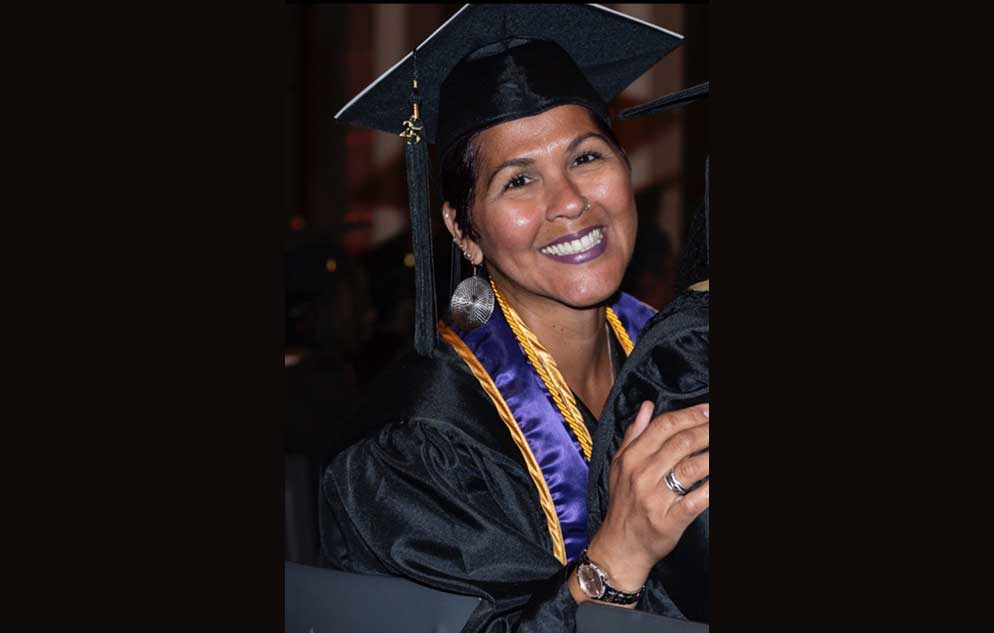
Some people go to university and can’t wait to get their degree and move on. And then there’s the people like me: you can’t keep me away from the classroom. And believe me—people have tried!
I’ve started at SLU before it was SLU. Back in the early 2000s, when it was the Murphy Institute, I was working at Heath + Hospitals as a clerical associate and was a member of Local 1549. In 2006, I got an email about pursuing an education. The union would cover 12 credits and I’d come away with an education and advanced certificate that could open up career opportunities. Say no more, I was all in.
But I was terrified—insecure, anxious, afraid of the what-if’s. I was convinced my peers would be smarter or more experienced or more articulate than me—all those things that came with higher ed. I grew up not having a support system. Born in the Bronx in the 1970s, I was raised during the crack epidemic. I saw a lot of abuse and overdoses around me. Because my childhood was heavy, I went straight to work. I needed to get out of my environment and the elements overwhelming me in life.
When I decided to go back to school, the nightmares started. I’d regularly dream that I never finished high school, despite the fact that I actually did. It amazes me to this day, but when I graduated with my first certificate, the nightmares stopped. I’d found therapy in learning. I realized I had a passion for remaining teachable and malleable. I still wonder if it’s because I felt so trapped growing up. I got my certificate in Public Health and Policy in 2009. I was hungry for more. As I continued to work at H + H, I returned to SLU and got a certificate in Healthcare Administration in 2013. That was it—I was deep, locked in for life.
Since then, I started my current job as executive assistant to the CEO of Resource Recovery Center of Orange County in 2022. I graduated from SLU with my bachelor’s degree in Urban and Community Studies in May 2025. I was also ordained as a pastor and became a certified Sexual Assault Response Advocate through a program at H + H. For that, I credit Professor Justin Laird, who saw in me something I didn’t see in myself. He showed me that I have a voice and an ability to advocate for poor and underserved populations. In his class, I wrote a paper about human sex trafficking and learned how that researchers predict that it will become the number one crime in the country. I’m talking bigger than drug trafficking. Think about it: you can sell a bag of drugs once, but a human being can be sold over and over. That paper has been engraved in my heart ever since.
And the most amazing part? It made an impression on Justin Laird, too. Now I’m in the master’s program, I took another healthcare administration class with him last year. He remembered my paper. I was so humbled that he remembered it from all those years ago. It told me I was doing something right.
Becoming a pastor has helped me stay on track. It’s a lens for reflecting and doing a self-check, which I always encourage everyone to do regularly, regardless of your faith. It ensures that we’re doing good and serving to the best of our ability—not questioning or judging, just aligning our beliefs with our responsibilities and helping people experiencing homelessness, incarceration, generational patterns of substance abuse and addictions. It takes someone to stop those cycles, and when you do that, you’ve stopped just saying something and started doing. I think that’s part of why we’re all here at SLU.