
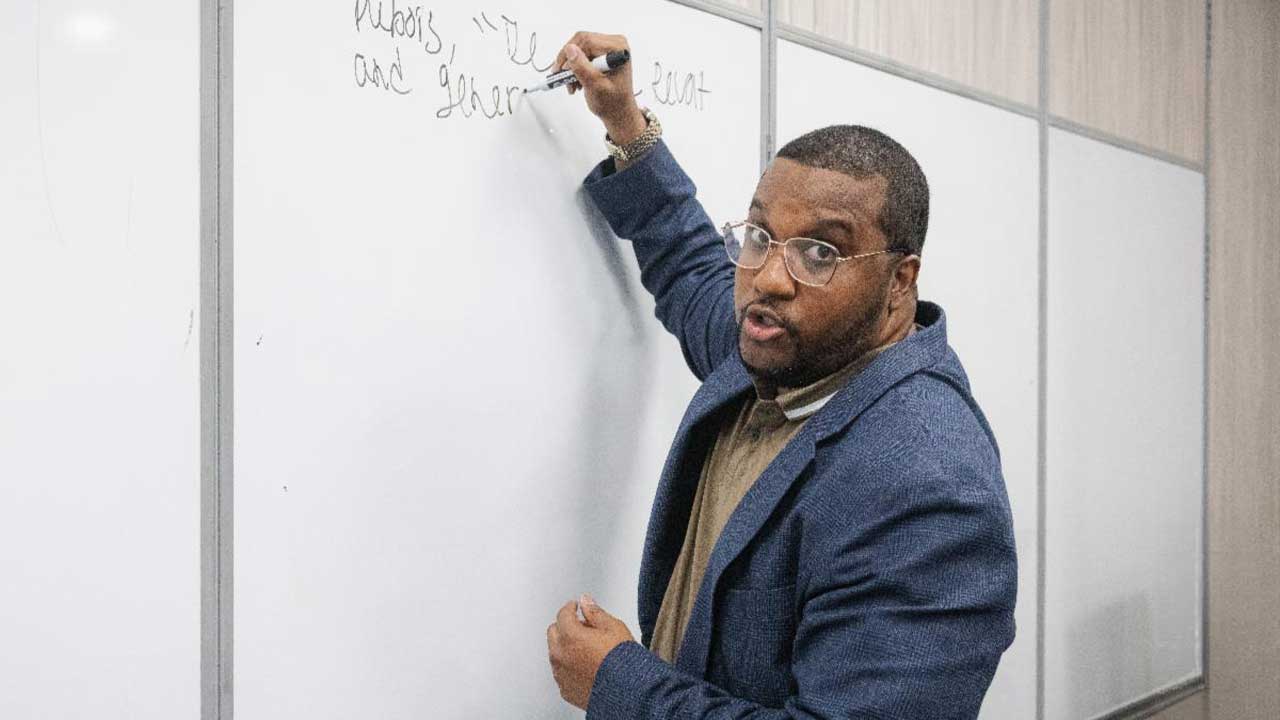
The first time that Assistant Professor of Labor Studies Cameron Black set foot in New York City was when he moved across the country to join the SLU faculty for the 2023-2024 academic year.
Prof. Black grew up in Orlando, Florida and attended college at Stetson University nearby, then taught History in middle school and high school. He went on to earn an M.A. and Ph.D. in History at UC Berkeley, coming to SLU immediately afterward. Black now makes his home in East Harlem with his fiancée, a fellow Berkeley alum.
At SLU, courses he teaches include U.S. Labor History; History of Capitalism, 1600-2000, and Capstone.
Prof. Black, 33, comes from an athletic family – he and his sister, mom, and dad all would go to the gym together – and played a lot of basketball. A major focus of his scholarship is about sports teams and how they relate to labor, culture, protest, and capitalism. He has a book forthcoming from the University of North Carolina Press on these themes, “From the Line of Scrimmage to the Picket Line: Student-Athlete Protest in an Age of Protest, 1968-1972,” as well as an upcoming New Labor Forum article, “A Game With Rules But No Regulations,” about college athletics, labor rights, and issues around NIL (name, image, likeness).
Even fantasy sports are a subject of research for Black: he expects to publish an article in the fall called “Fantasizing Surveillance: Sports and Statistics as Forms of Surveillance, 1900-2020.” He explains: “It examines fantasy sports and how athletes are transformed into ‘statistical people,’ enabling broad commodification of their labor.”
Why Labor Studies?
I get to write and think about labor, capitalism, all of these different things that really interest me.
Labor history jobs are actually quite rare. When I applied, there were only three on the market. I saw SLU’s listing, looked up the faculty, and thought they seemed fascinating. The school also seemed very student focused, which not every school is. Going through the interview process, I felt comfortable with the school, the faculty, and the students. That’s how I ended up here — partly by accident, partly intentionally.
What made you a professor?
I actually wanted to work for the U.S. Department of Labor. I never really expected that I would become a professor — this happened on accident.
When I was a graduate student instructor for my advisor, we got really, really great reviews. Many of my students were like, ‘he’s actually really, really tough, but I learned so much from him.’ That meant a lot to me. I’m like, ‘okay, this might be something I could do.’
Professing is pretty great… it is almost like a pseudoidentity. It’s who you are, and in many ways, I kind of like that.
What do you find special about SLU?
We have really remarkable, really fantastic and passionate students that really like to engage with both the professor, the materials, and the world at large. And that’s not common. It really makes teaching at SLU truly a joy.
Everyone at SLU, at least in my experience, is really interested in or passionate about something in the subject matter. And they are also really passionate and interested in how the subject matter applies to the world.
What do you find special about SLU students?
SLU students include both younger, justice-minded students and working civil service professionals. In class, they jell well.
Many younger students are interested in the experiences of the workers, and many of the workers are overjoyed at being listened to. It’s a great mixing pot of both experience and interests.
Throughout my academic career, I have encountered students who are there only because of a requirement. At SLU, I haven’t experienced that.
What do you want students to get out of your classes?
I want students to have more appreciation for history as a force in their lives. History is not dead. As William Faulkner noted, the past isn’t dead: it isn’t even the past!
I would also like for them to simply become more avid readers, and to become more proficient and interesting writers.
My students have said they’ve become ‘history junkies’ after taking my class. It’s one of the highest compliments I could possibly receive.
Books I recommend:
The Men of Mobtown: Policing Baltimore in the Age of Slavery and Emancipation by Adam Malka — Great for history and policing.
Necropolis: Disease, Power, and Capitalism in the Cotton Kingdom by Kathyrn Olivarius — Students find it mind-blowing, especially its resonance with COVID and Southern attitudes toward disease.